
How Stress Creates Chronic Pain
Dec 08, 2025Read the blog post or watch the video-version on YouTube. You'll find both below!
Most people think pain comes from the body. The logic sounds usually something like this: if something hurts, something must be physically damaged.
What most people are unaware of or fail to consider is the fact that all pain is generated in the brain.
That means the brain can turn pain on, turn it up, or turn it off depending on whether it thinks you are safe or in danger. And stress (especially long-term, emotional, or hidden stress) can trigger this danger response even when nothing is physically wrong.
In this article, we’ll break down the science of how stress creates pain, why chronic pain often persists long after an injury heals, and how you can retrain the brain to break the cycle.
Your Brain Has One Job: Keep You Alive
The key to understanding stress-related pain is this: The brain constantly scans for danger.
Every second, your nervous system assesses whether the environment is safe or threatening. And in the presence of threat, physical or emotional, it prioritizes one thing: Survival now. Healing later.
This comes from the autonomic nervous system, which has two main modes:
1. Fight or Flight (Sympathetic Nervous System)
This is when your heart rate goes up, muscles tense, digestion slows and breathing becomes shallow. Your high stress levels are sending signals to your brain telling it that you’re not safe, and that sends it into survival mode.
In the good ol’ days when most of us lived as hunter-gatherer, this mode usually got activated in life-or-death situations. That could be an encounter with a predator, natural catastrophes or illness.
Today, it’s triggered by deadlines, overthinking, relationship problems, fear of disappointing others, financial pressure, overwhelm and criticism or rejection.
Your brain does not distinguish between being chased by a lion or reading an email that stresses you out. Both activate the same danger circuits.
2. Rest and Digest (Parasympathetic Nervous System)
This is your healing mode. It’s the state in which digestion, immune repair, tissue healing, and emotional processing occur.
Here’s the issue:
Modern life keeps most people in low-level fight-or-flight all day long.
Traffic → work → obligations → social pressure → constant notifications → unresolved emotions.
Your body rarely gets the downtime it needs to reset. Over time, this chronic stress can change how the brain interprets bodily signals and activates pain even when there is no tissue damage.
Stress Changes How the Brain Interprets Sensations
Pain is not a direct measurement of injury. It’s a protective output of the brain.
When you sprain your ankle, for example, pain is not produced by the ankle, it’s produced by the brain in response to signals coming from the ankle.
But here’s where it gets fascinating: Emotional stress activates the same brain circuits as physical injury.
Whether the threat is physical (you stub your toe) or emotional (someone criticizes or rejects you), the same neural protection pathways light up in the brain.
When these areas interpret something as a threat, they increase protection. And one of the strongest protection-tools the brain has is pain.
This is why back pain can flare during stressful life periods, migraines often appear after emotional overwhelm, IBS worsens with stress and anxiety, and pelvic pain increases during fear or perfectionism cycles.
The pain is real because the neural circuits producing it are real. But it’s happening in the brain, not the tissues.
This is what we call neuroplastic pain: pain caused by the brain’s neural pathways rather than structural damage.
The Fear-Pain Cycle: The Loop That Keeps Pain Alive
Once pain begins, the brain quickly forms a pattern:
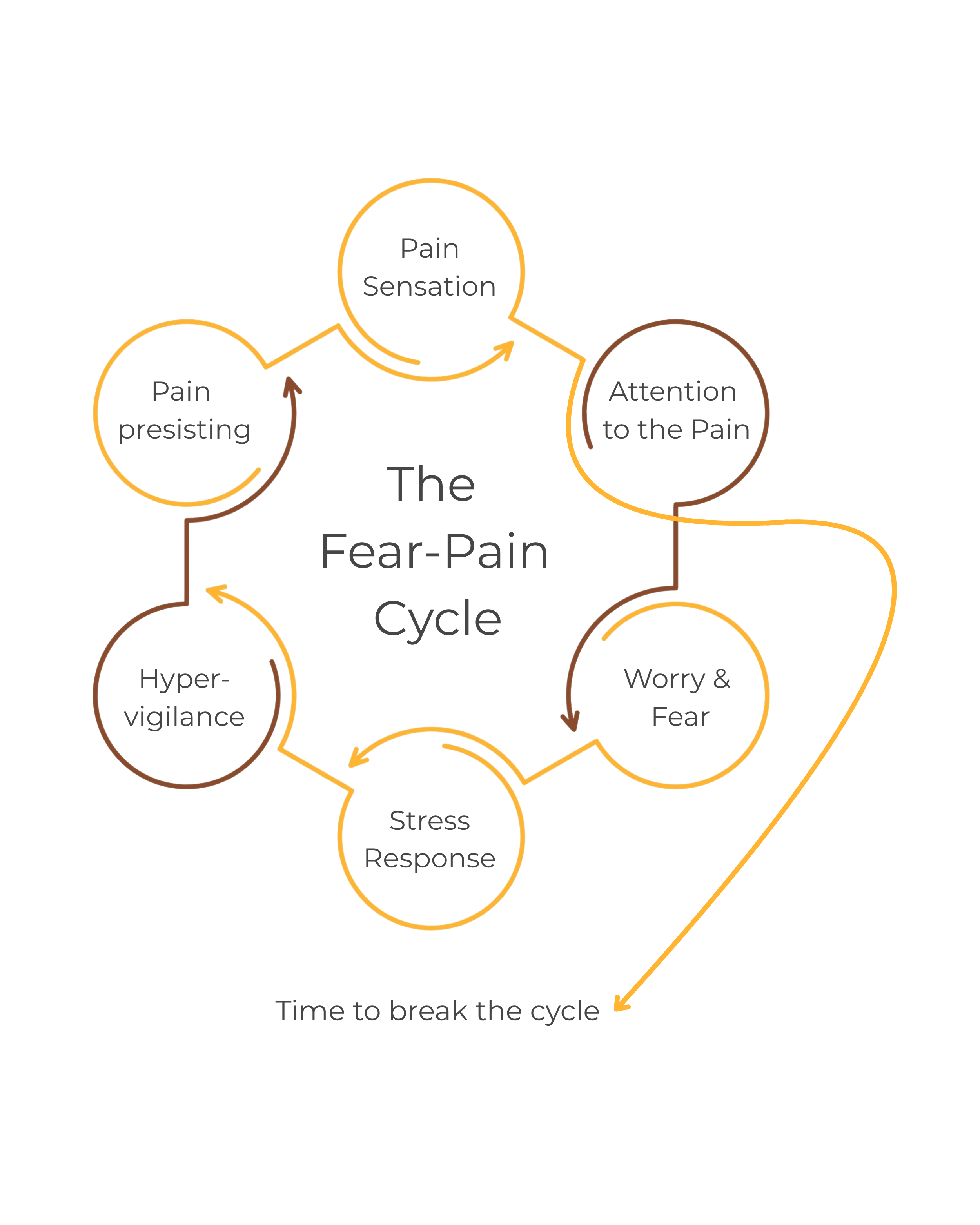
Here’s how the cycle forms:
- You feel pain
- You focus on the pain and scan your body for more pain
- You get worried (“What if this never goes away?”)
- Your stress response activates (muscles tighten, breathing becomes shallow, nerves become sensitized)
- The brain perceives increased danger through hypervigilance
- The pain persists
This loop can become self-sustaining. After a while, the original injury heals, but the neural circuits of danger and pain remain active.
That's why someone can experience ongoing back pain with no structural findings, migraines despite normal scans, joint pain with normal imaging, pelvic pain with no physical cause and burning, tingling, or pressure with no medical explanation.
The brain has essentially learned the pain pathway and keeps firing it.
Breaking the Cycle: How to Teach the Brain Safety Again
The good news is that neuroplastic pain can be reversed. If the brain can learn pain, it can unlearn it too.
The two primary ingredients are:
1. Teaching the Brain Safety
When the brain stops perceiving danger, it stops producing protective pain. This can be achieved through hypnotherapy, somatic tracking, neural circuit retraining, nervous system regulation and interruption of the fear-pain cycle.
Hypnotherapy plays a key role because it helps calm the amygdala, shift the brain into parasympathetic dominance, rewire fear-based pathways and instill new neural pathways.
This is why hypnosis is so effective for chronic pain. It helps reprogram the protection system at the subconscious level.
2. Processing Emotions Instead of Suppressing Them
Unprocessed emotional stress is one of the strongest activators of physical symptoms.
When emotions get suppressed rather than expressed, the brain interprets this as internal conflict or danger.
Typical emotional triggers that worsen pain include:
- people-pleasing
- perfectionism
- heightened sense of responsibility
- putting others need before your own
- frustration and resentment
Teaching the nervous system to feel emotions safely is a major step toward shutting off chronic pain circuits.
Why Neural Circuit Retraining Works
The underlying principle is neuroplasticity: the brains ability to change its structure and function based on stimuli.
When clients learn to reduce fear, respond differently to sensations, lower stress, shift into parasympathetic states and experience emotions without threat, the brain starts to feel safe again.
When that happens, pain naturally decreases (sometimes gradually, sometimes dramatically.)
Stress and Pain Are Deeply Connected
Pain is not just a physical event happening at the site of a symptom. It is a brain-generated protective mechanism influenced by thoughts, emotions, stress levels, past experiences, personality patterns and perceived danger.
Understanding this connection doesn’t make the pain any less real, it simply gives you a pathway out.
When you teach the brain that the body is safe, the fear-pain cycle breaks. And once the cycle breaks, healing begins.
Ready to Retrain Your Brain?
If you're dealing with stress-related or chronic pain, you’re not broken, and it’s not “all in your head.” Your brain is doing what it can to protect you. When you learn how to calm the nervous system and teach the brain safety, everything changes.
This is exactly what we help clients do through hypnotherapy and neural circuit retraining.
If you’re reading this and thinking, “This sounds like me…” you’re not alone.
Many people live with neuroplastic pain for years without realizing that their symptoms are reversible.
To find out whether your symptoms fit the pattern of neuroplastic pain, you can take our neuroplastic pain assessment.
It only takes a few minutes and will help you understand whether your pain may be driven by reversible neural pathways rather than structural damage.
Join the Mind-Body Connection newsletter
Weekly newsletters on how you can retrain your brain, and break out of the cycle of fear and pain.
Our readers are our only priority. See our privacy policy at the bottom of the page.
